Microcontroller Debugging Lab Report
| Name | ID |
|---|---|
| Mohammed Hany Mohammed | 2201377 |
| Ziad Omar Ahmed | 2200533 |
| Youssef Shaban Hassan | 2200455 |
Phase 1: Setup and Simulation
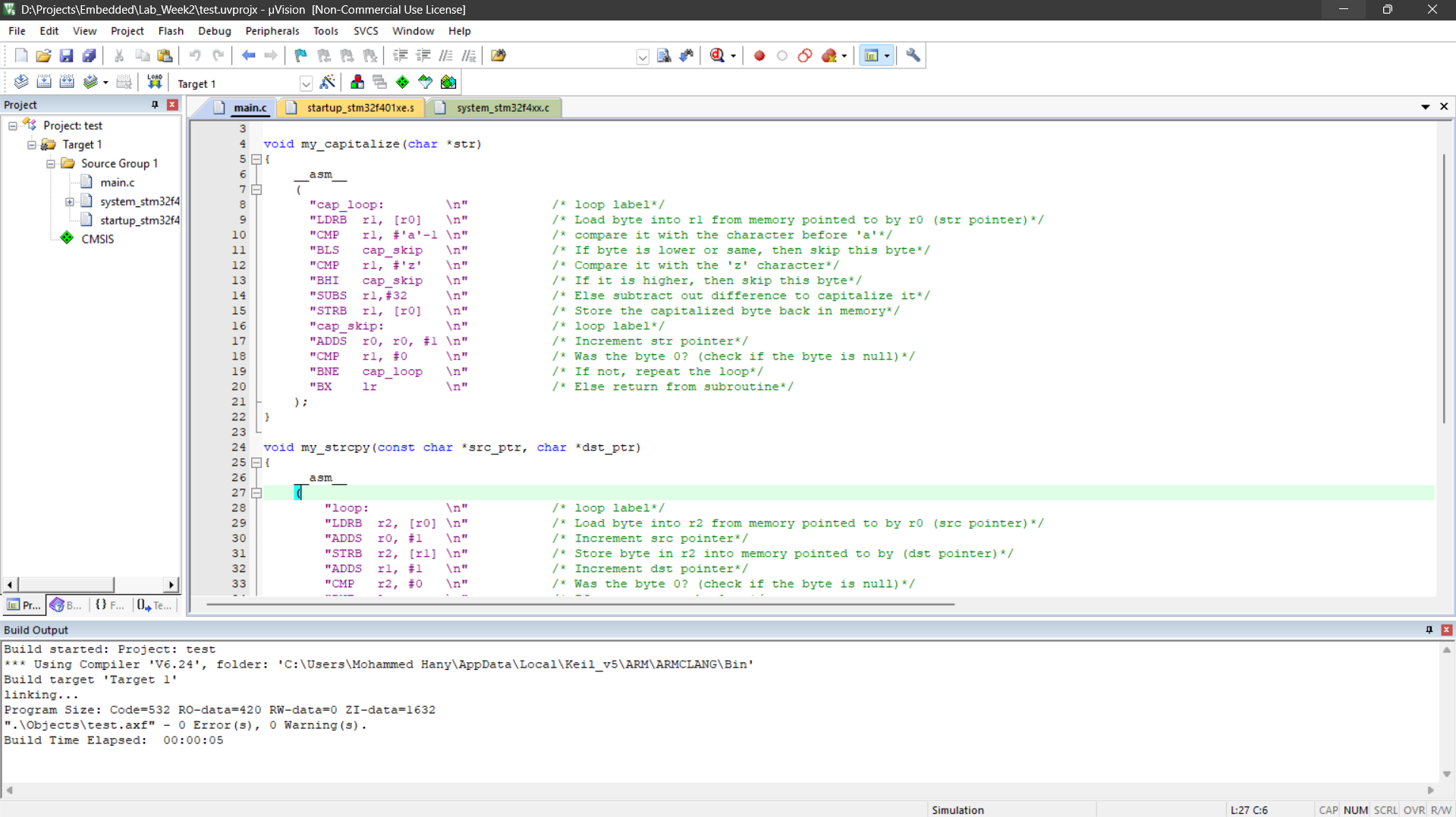
1. Code Compilation
The project code was successfully compiled with no errors prior to debugging.
2. Simulation Environment Configuration
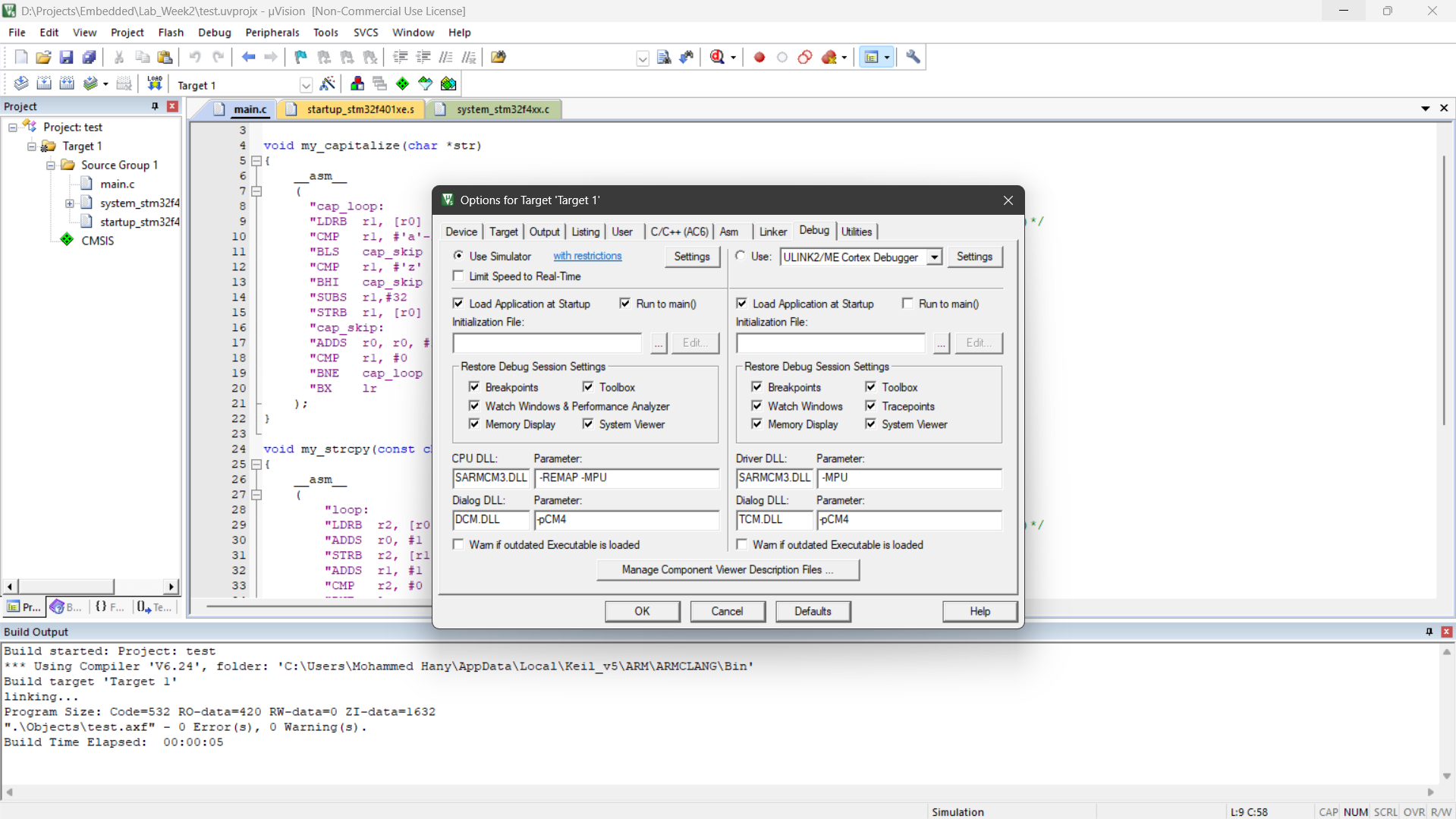
The debug settings were adjusted to utilize the software simulator rather than flashing a physical board.
Phase 2: Execution Flow and Disassembly Analysis
3. Halting Execution at main()
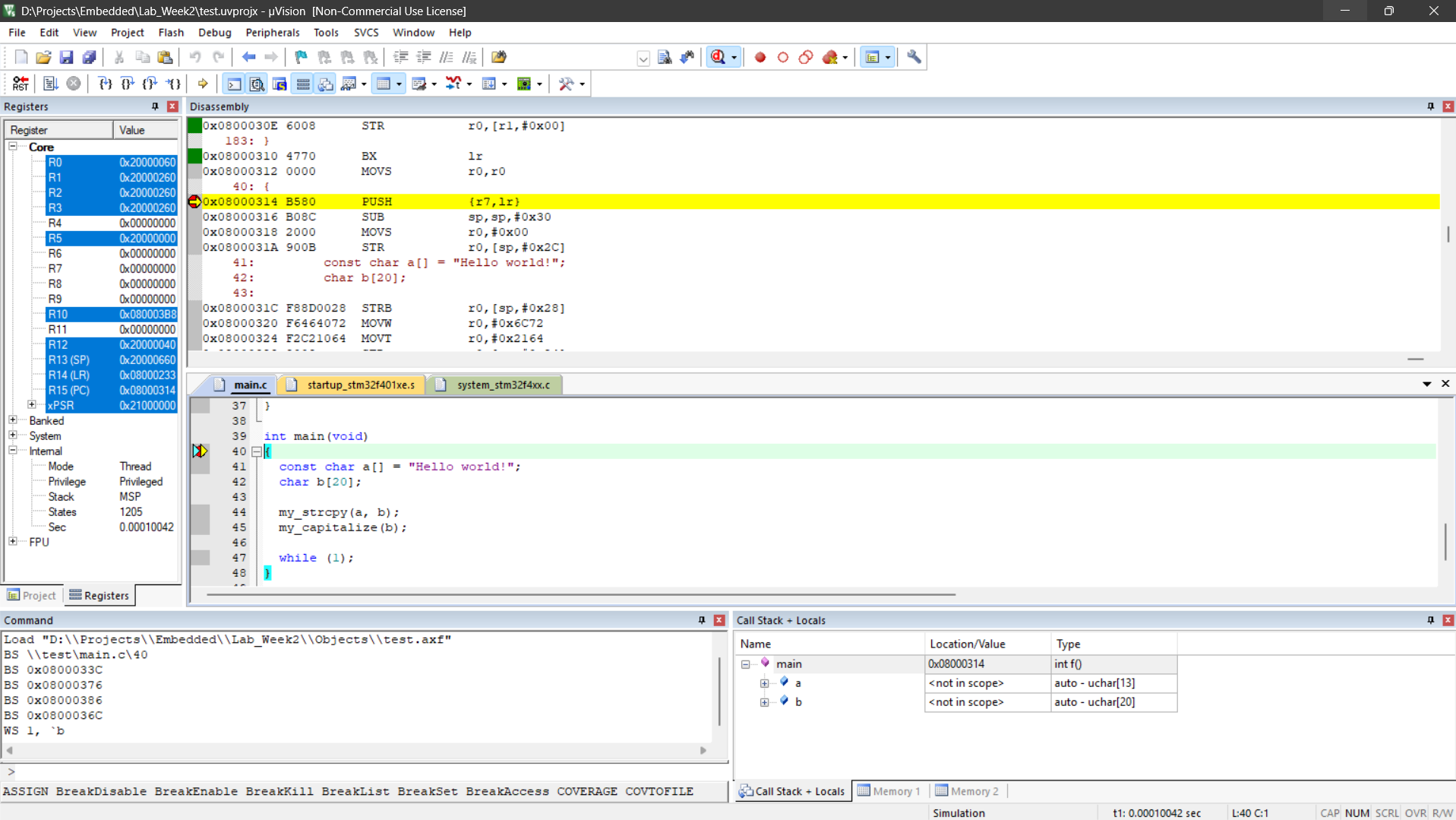
A breakpoint was utilized to pause the program immediately at the start of the main function. The core CPU registers at this exact moment were:
| Core Register | Hexadecimal Value |
|---|---|
| Stack Pointer (R13/SP) | 0x20000660 |
| Link Register (R14/LR) | 0x08000233 |
| Program Counter (R15/PC) | 0x08000314 |
4. Disassembly at Program Entry
- Instruction:
PUSH {r7,lr}(Opcode:B580) located at0x08000314. - Observation: This memory address directly corresponds to the current value of the Program Counter (PC).
5. Post-Instruction State
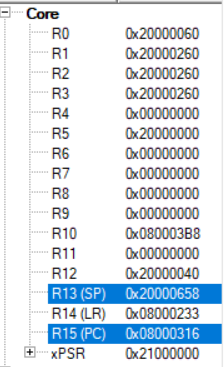
Executing the initial PUSH instruction modified two crucial registers:
- SP (R13): Decreased from
0x20000660to0x20000658. This shift occurred because two register values were pushed onto the memory stack. - PC (R15): Incremented by 2, moving to the next sequential instruction (accounting for the standard 2-byte instruction spacing).
6. Locating 32-bit (4-byte) Instructions
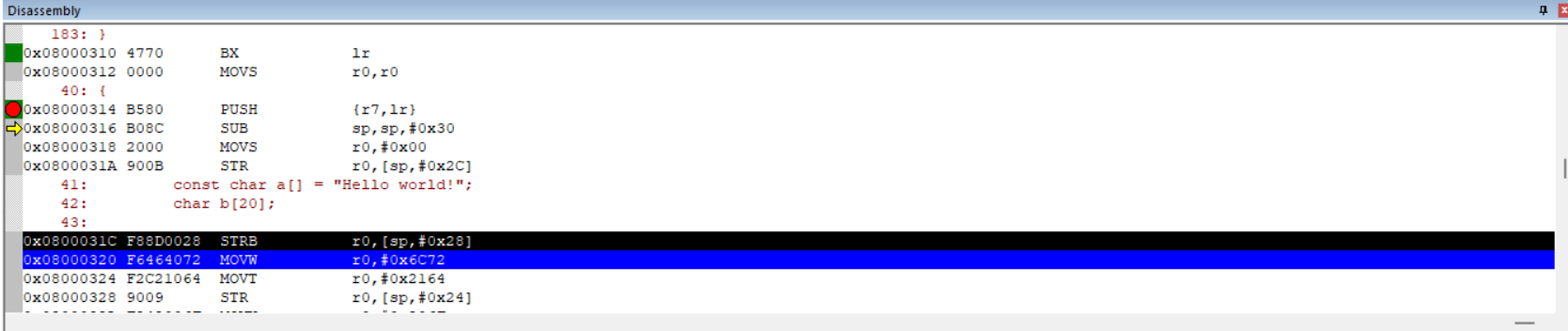
Phase 3: Analyzing Function Calls (my_strcpy)
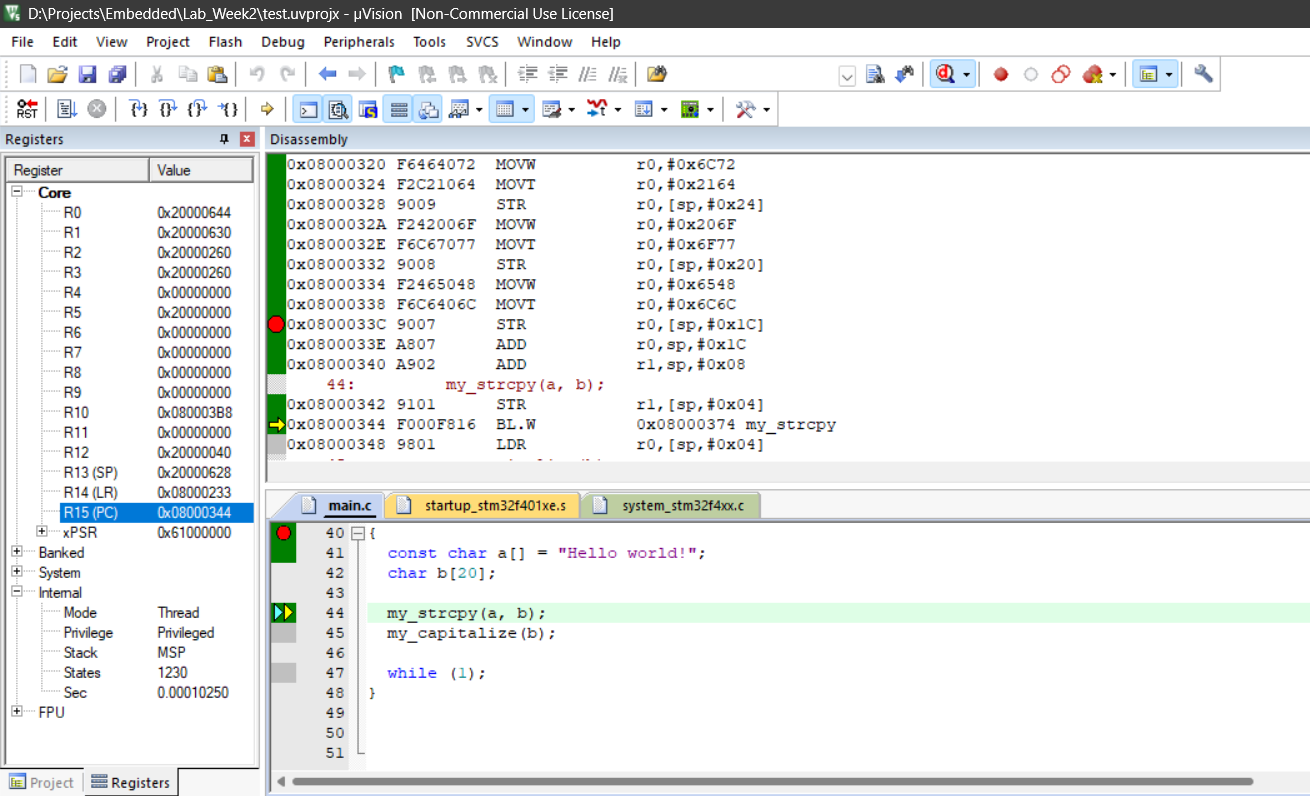
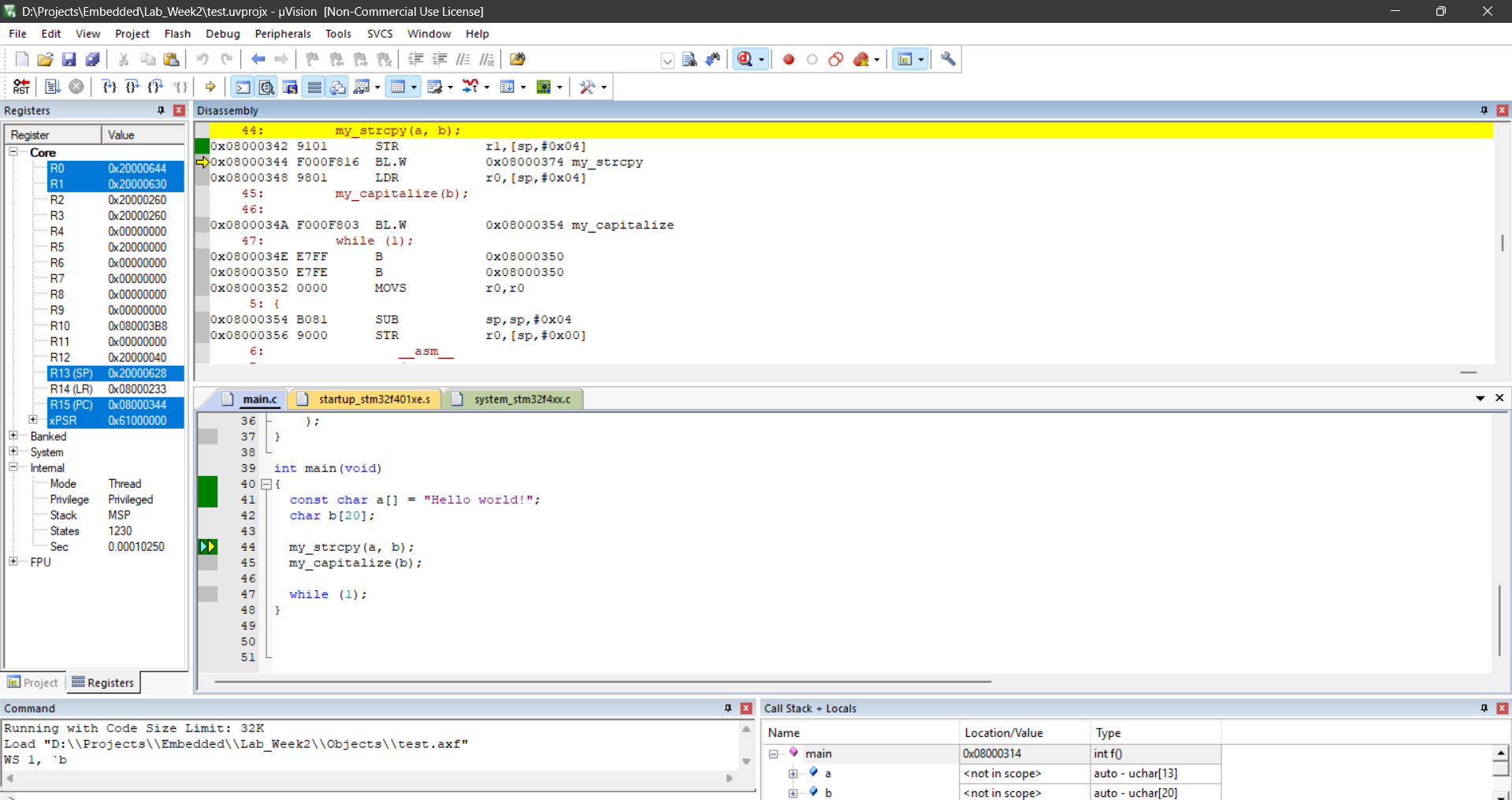
7. Register State Prior to Function Call
Before stepping into the custom string copy function, the core registers were captured as follows:
| Core Register | Hexadecimal Value |
|---|---|
| SP (R13) | 0x20000628 |
| LR (R14) | 0x08000233 |
| PC (R15) | 0x08000344 |
8. Stepping Into my_strcpy
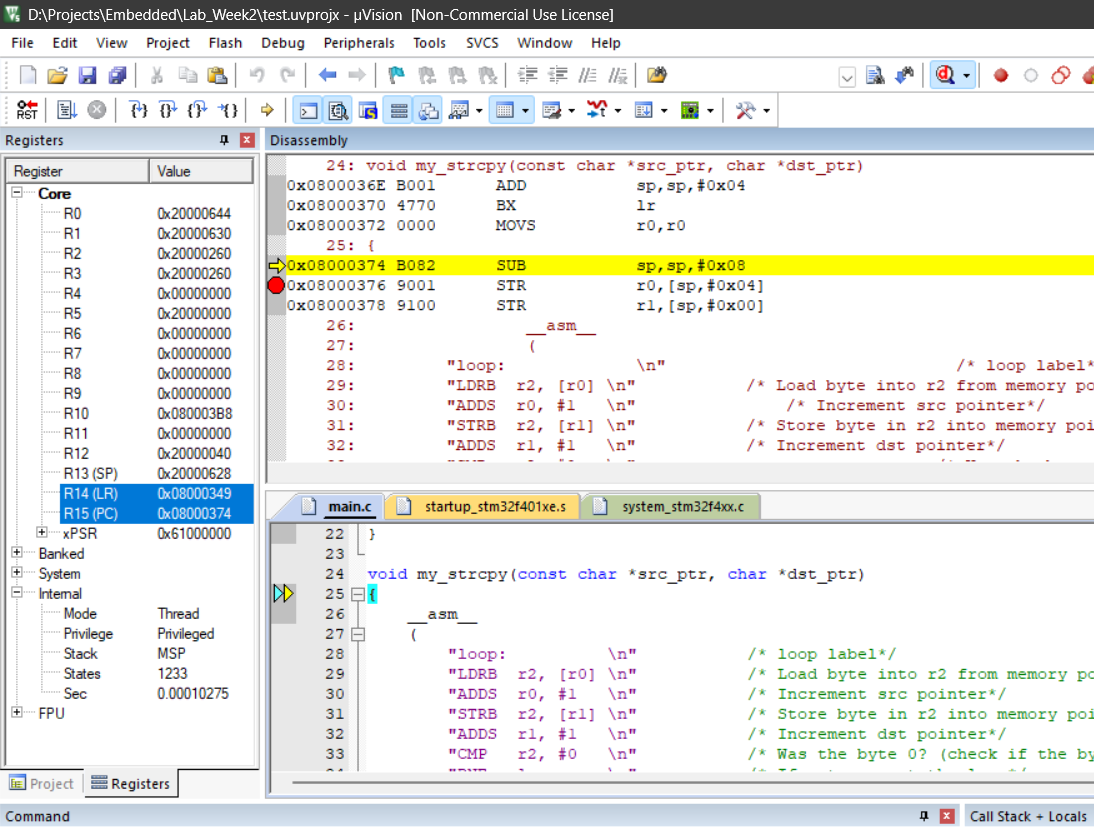
Upon jumping into the function, the registers updated to reflect the new execution context:
| Core Register | Hexadecimal Value |
|---|---|
| SP (R13) | 0x20000628 |
| LR (R14) | 0x08000349 |
| PC (R15) | 0x08000374 |
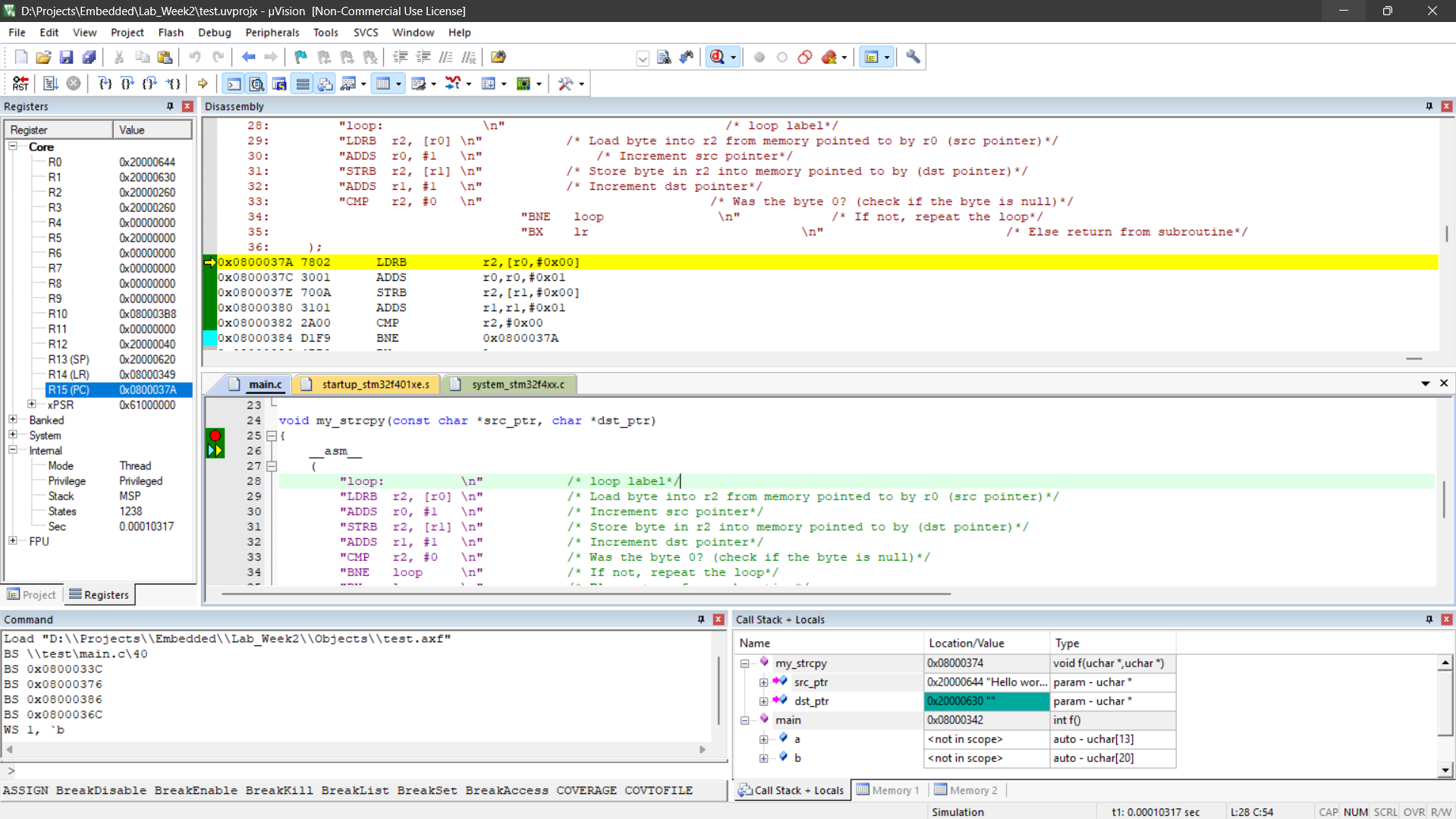
Analysis: The Link Register (LR) was updated to store the return address. Simultaneously, the Program Counter (PC) was updated to the address of the first instruction inside the function, matching the disassembly window.
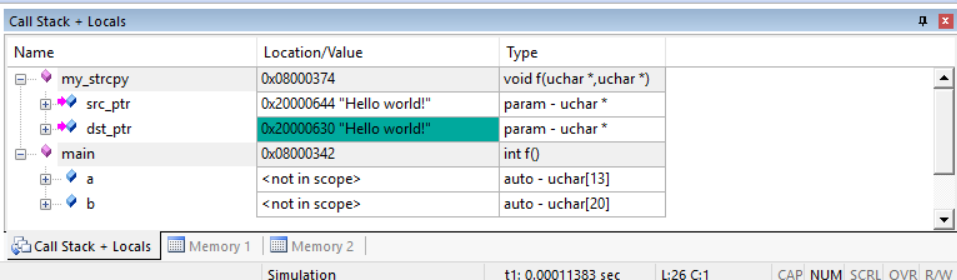
9. Function Argument Passing
The arguments passed into the function were loaded into the standard low registers:
| Argument | Assigned Register | Value / Data |
|---|---|---|
src_ptr |
R0 (0x20000644) |
"Hello, world!" |
dst_ptr |
R1 (0x08000630) |
"" (Empty) |
10, 11, & 12. Memory Window Inspection
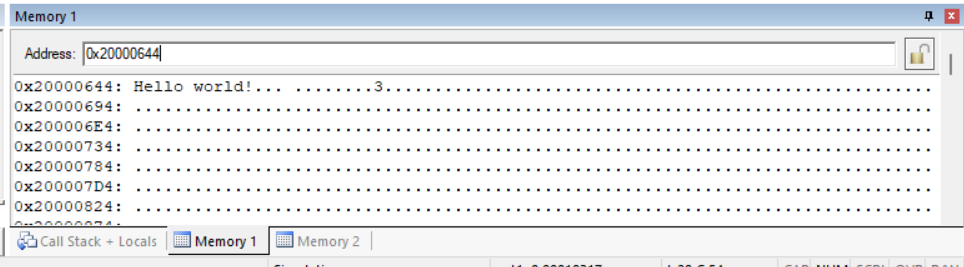
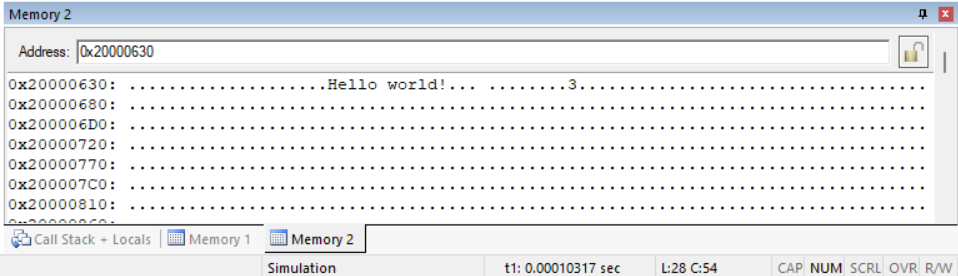
Using the memory viewer, the exact contents pointed to by the argument registers were verified:
| Pointer Variable | Memory Content |
|---|---|
src_ptr |
Hello, world! |
dst_ptr |
. |
13. Register Roles During Execution
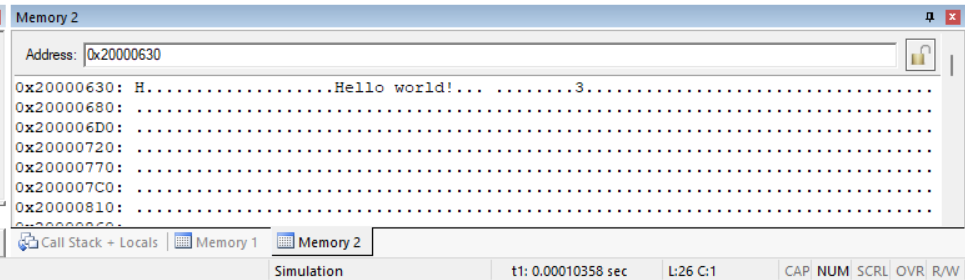
During the active copying process, specific registers were assigned the following tasks:
| Register | Specific Function |
|---|---|
| R0 | Acts as the pointer to the source character being copied. |
| R2 | Temporarily holds the character data during transit. |
| R1 | Acts as the destination pointer where the character is pasted. |
Phase 4: Function Exit and Validation
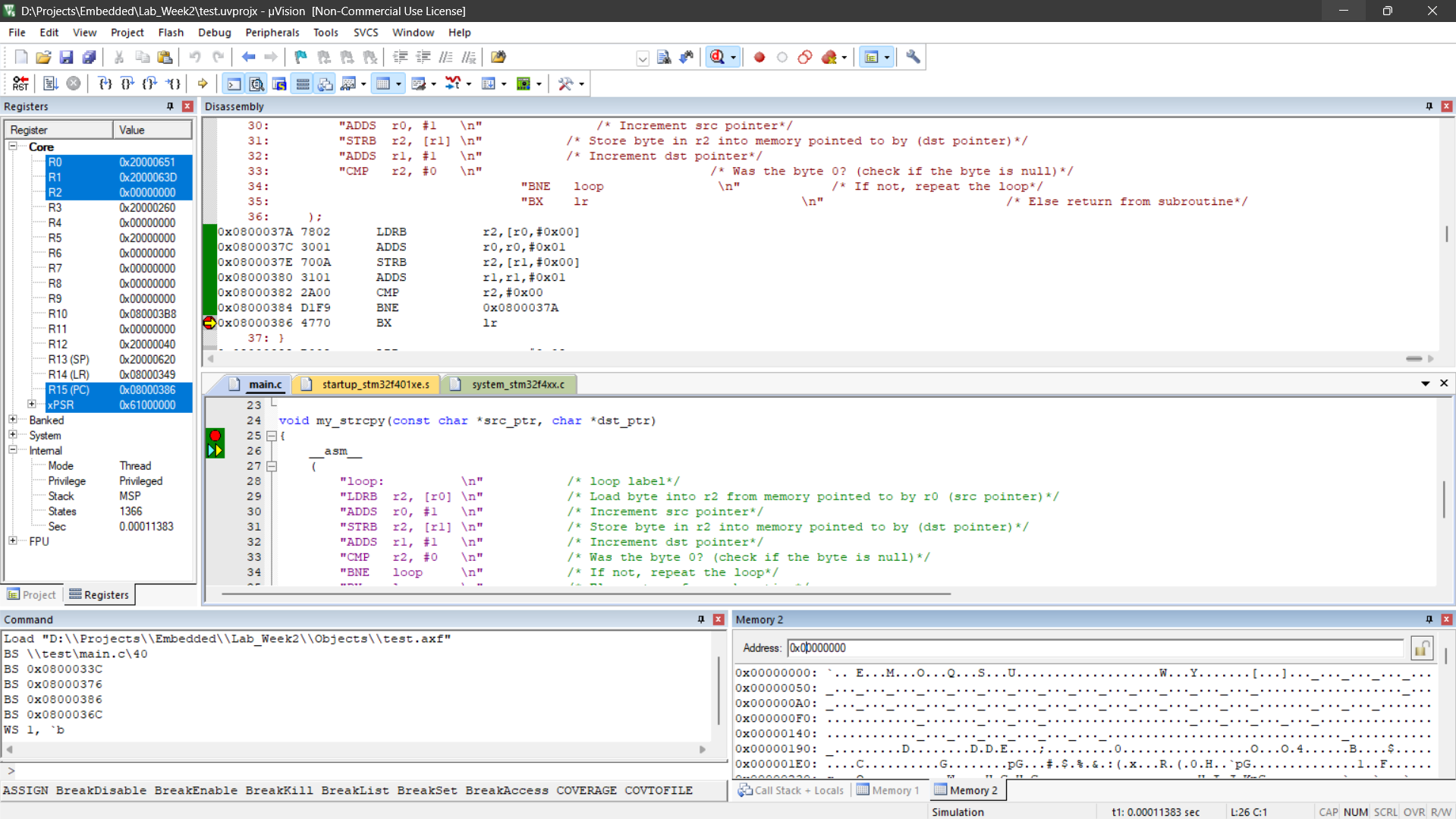
14. State Prior to Function Return
Right before stepping out of my_strcpy, the execution registers showed:
| Core Register | Hexadecimal Value |
|---|---|
| SP (R13) | 0x20000620 |
| LR (R14) | 0x08000349 |
| PC (R15) | 0x08000386 |
15 & 16. Returning to Main
After successfully stepping out of the function, the Program Counter updated:
- New PC (R15):
0x08000348
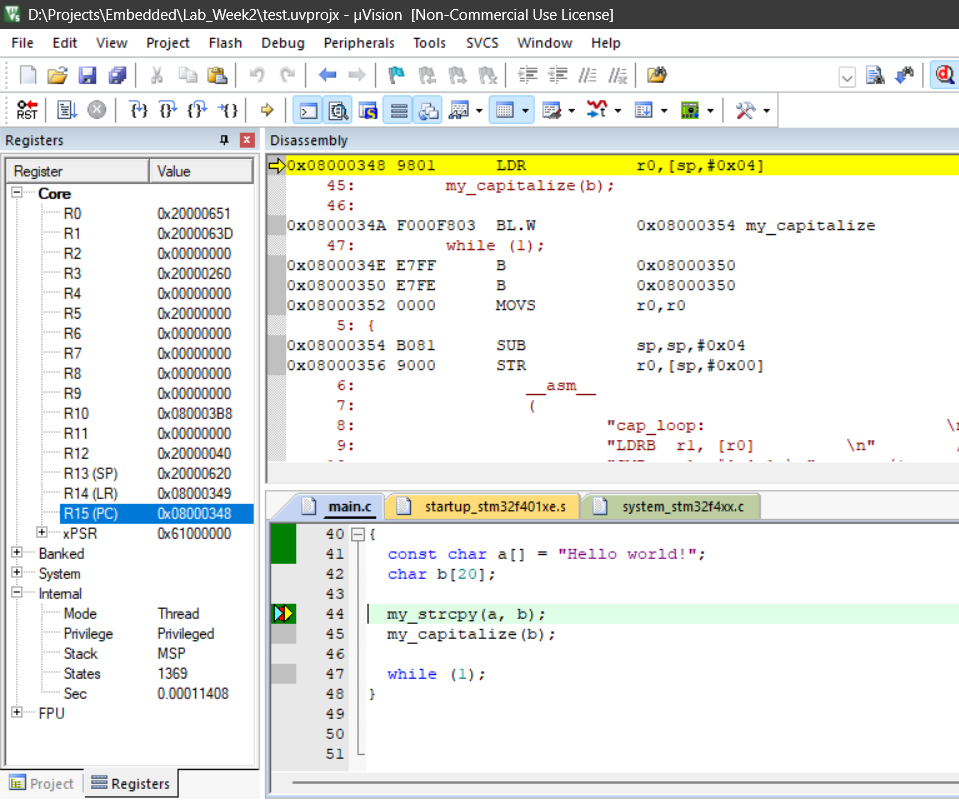
Relationship: The Program Counter is now effectively equal to the return address previously held in the Link Register (LR). The program execution has successfully navigated back to the point in main immediately following the function call.
17. Final Validation
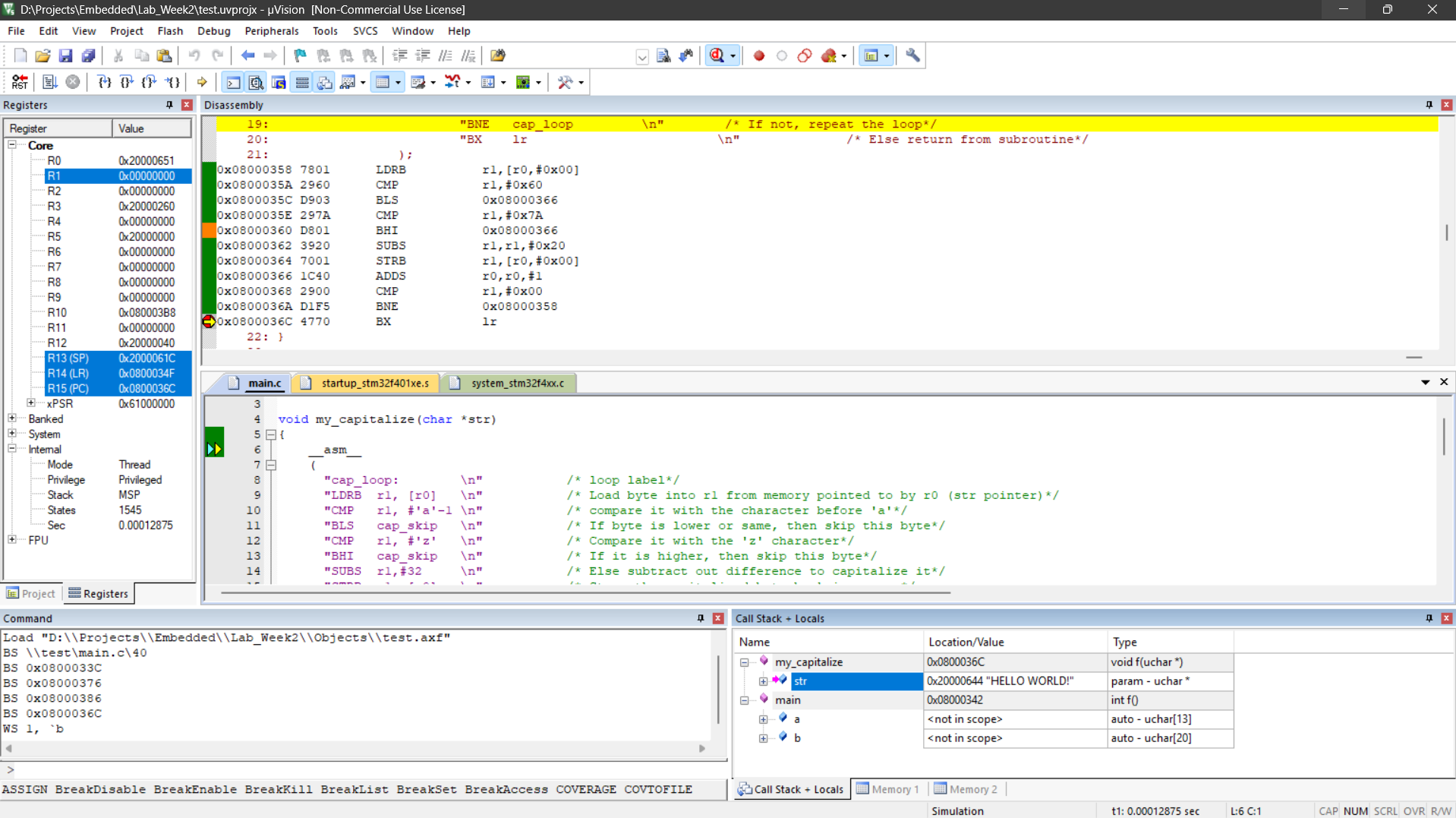
The subsequent my_capitalize function was also executed and verified.