Critical Resonance Damping and Vanishing Resonance
When the damping ratio
1. The Math of the Resonant Frequency
The formula for the resonant frequency (
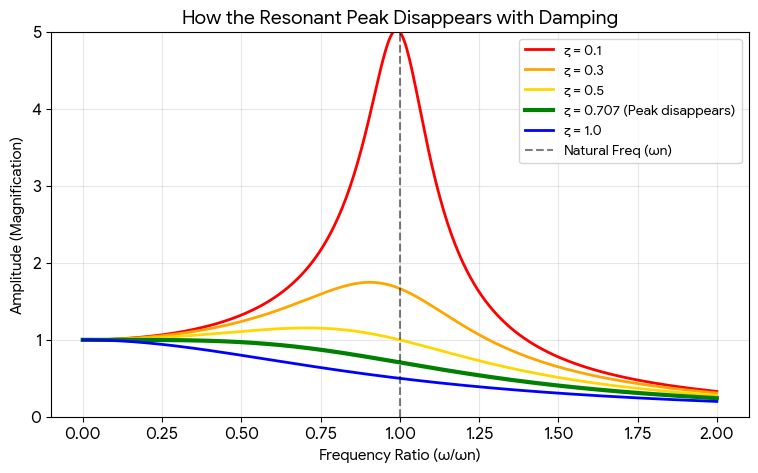
If you plug in
When
2. Physical Interpretation
Below : The system still has enough "springiness" relative to its "friction" to create a distinct hump (resonance) where it vibrates more intensely than at a standstill. At : This is called Butterworth or maximally flat damping. The system transitions from a curve with a "peak" to a curve that simply rolls off smoothly. Above : The damping is so dominant that the system's response immediately begins to drop as frequency increases. There is no frequency where the system "helps" the motion; the "brakes" are always stronger than the "bounce."
Since
- If you hit it: It will still oscillate (bounce) slightly before stopping.
- The Difference: While it still "bounces" in free vibration, it no longer "amplifies" in forced vibration.
The threshold of
Here is how it fits into the hierarchy:
2. The "Resonant Peak" Threshold
This value divides the Underdamped category into two distinct behaviors:
-
Lightly Underdamped (
): - The system has a resonant peak.
- If you shake it at the right frequency (
), the output will be larger than the input. - Example: A glass that shatters when you sing the right note.
-
Heavily Underdamped (
): - The system has no resonant peak.
- The output is never larger than the input, no matter how fast you shake it.
- Example: High-end audio speakers or professional microphones designed to be "flat" and accurate.
3. Master Table
Adding this "Magic Number" to the classification:
| Damping State | Damping Ratio ( |
Resonant Peak? | Physical Feel |
|---|---|---|---|
| Undamped | Infinite | Eternal vibration. | |
| Lightly Underdamped | Yes | Bouncy; amplifies certain frequencies. | |
| Maximally Flat | None | Slight bounce; perfectly smooth response. | |
| Heavily Underdamped | None | Tiny bounce; sluggish response. | |
| Critically Damped | None | Zero bounce; fastest possible settle. | |
| Overdamped | None | Heavy, slow, "muddy" movement. |
System:
- Oscillates forever at constant amplitude with
- Oscillates at a decaying amplitude with
- Doesn't oscillate (no overshoot) and arrives at the set point in fastest time when
- Doesn't oscillate (no overshoot) but the system arrives at the set point more slowly when
| Feature | Undamped | Underdamped | Critically Damped | Overdamped |
|---|---|---|---|---|
| Damping Ratio | ||||
| Oscillation? | Yes, constant | Yes, decreasing | No | No |
| Speed to Equilibrium | Never reaches | Slow (due to oscillation) | Fastest | Slow (due to high damping) |
| Roots of Characteristic Eq. | Pure imaginary | Complex conjugate | Repeated real | Distinct real |
Why
It comes from the geometry of the complex plane. At
3. Real-World Application: Audio & Sensors
Engineers often aim for
- The Goal: You want the sensor to report the signal accurately across a wide range of frequencies without "ringing" or artificially boosting certain notes (resonance).
- The Result: It provides the widest possible frequency range where the output stays exactly 1:1 with the input before it starts to fade.